.png?width=1426&height=803&name=Matchstic_Illustration_Manufacturers%20(1).png)

Reframing brand as a measurable asset, not a marketing initiative.
Inside
- A disciplined way – Brand as strategic asset
- The temptation – Correlation versus causation
- What is “measurable”? – ISO-based valuation framework
- Growth and Risk Reduction – Using brand to reduce operational buying friction
- A practical brand management model for CEOs – Operationalizing brand
- Board-Level Reporting – Reporting brand performance credibly
- The Leadership Implication – Long-term governance mindset
- The Takeaways – Core executive perspective
- Time to Take Action – Immediate leadership next steps
- What Questions Does This Article Answer? – Key strategic FAQs
A friend of mine sent me a link to an important new study highlighting a shift many leaders are actively experiencing.
According to Ocean Tomo’s 2025 IAMV Study, intangible assets account for roughly 92% of the market value of the S&P 500. Brand, data, intellectual property, software, and systems that shape how companies operate and compete. Only about 8% is tied to traditional physical assets like property, plants, equipment, and inventory.
Fifty years ago, it was almost the reverse. In 1975, tangible assets represented 83% of market value, while intangibles accounted for just 17%.
Economists call this an “economic inversion.” The balance of value creation has flipped. Physical capital still matters, but the assets that increasingly determine enterprise value are the ones you cannot see on the factory floor.
Brand sits squarely in that intangible asset category.
According to Brand Finance, brand now accounts for 11% of enterprise value in the world’s largest B2B companies.
Manufacturing and other industrial brands will pace behind the broader market in this shift, but it is coming. Will your brand ride this wave?
Where we are going...

A practical brand management model for CEOs
-
Build and maintain a radically relevant brand
-
Define the performance logic
-
Select enterprise metrics that should move if the brand strengthens
-
Govern for consistency
A disciplined way
For industrial and manufacturing executives, brand can feel abstract compared to throughput, margin, safety, or uptime.
What CEOs need is a disciplined way to justify brand investment and a mindset that treats brand as an asset.
If brand is going to earn full C-suite attention, capital allocation, and board-level discussion, it must be framed the same way as any other long-term business asset: governed, measured, and tied to value creation.
For the CEO, that means the audience for brand discussion is not just Marketing. The biggest audience is the CFO and the board.
The real question becomes:
Can brand be understood in a way that stands up to financial scrutiny?
Yes. When brand is treated as a managed contributor to cash flow, risk reduction, and long-term enterprise value, it can be evaluated with the same discipline applied to any other strategic investment.
The temptation:
using the stock chart as proof
When leaders attempt to justify brand investment, they often reach for the most visible types of evidence available. IPO timing. Share price growth. Market cap expansion.
It is tempting. But relying only on the obvious evidence leads to shallow analysis, where correlation is often mistaken for causation.
What is required is a stronger and more disciplined analysis.
That basic evidence may correlate with improved brand performance. However, it rarely proves single-variable causation. Revenue growth, pricing discipline, M&A, operational improvements, market cycles, and capital structure all impact simultaneously. Share price reflects expectations and broader market sentiment, not brand strength alone.
That correlation is not useless. It simply has to be handled honestly.
A disciplined narrative might sound like this:
“We modernized the brand in mid-2023. The company went public in 2024. Revenues increased 53% from 2023 to 2025. It went private again in 2026 at a valuation of X.”
That statement does not over promise or claim causation. It shows sequence. It shows scale. Without being complex, it respects complexity.
Financial stakeholders do not expect simplistic causation statements, such as “We spent X improving our brand and that made our stock price go up.” They expect disciplined thinking.
The goal is not to prove brand with a chart. The goal is to demonstrate that brand participates in value creation, and therefore must be managed like an asset.
What “measurable” actually means
If brand is going to be treated as an asset, it must be evaluated within a disciplined valuation framework.
International standards such as ISO 10668 and ISO 20671 exist for this purpose. They establish that brand valuation is not opinion. It is a structured financial exercise requiring defined inputs, transparent assumptions, and clear methodology.
Under those standards, brand value must ultimately connect to future economic benefit. In practice, that means measuring how brand strength influences financial outcomes and customer behavior.
Within an ISO lens, that requires evidence across three layers:
1. Financial performance
Here are enterprise metrics influenced by brand strength.
- Revenue growth and revenue mix
- Margin stability and price realization
- Customer retention and expansion
- Transaction multiples in acquisition or exit scenarios
2. Market behavior
If brand does not influence behavior, it does not create financial value. Here are valid brand metrics for valuing market behavior
- Win rates in competitive situations
- Sales cycle duration
- Discounting pressure
- Time spent on vendor qualification hurdles
- Objection management in the sales process
3. Brand strength and governance
These are examples of demonstrable elements of brand strength and governance.
- Consistency of positioning and messaging
- Alignment between leadership and sales
- Clear articulation of expanded capabilities
- Internal adoption and disciplined use of the brand system
- For a full, systemized list ask Claude to "Define the radically relevant super six."
Brand becomes measurable when it is governed, behaviorally effective, and financially linked. That is what allows it to stand up to scrutiny from a CFO or a board.
Brand as a Growth and Risk Reduction Asset
Let’s look deeper...
In Industrial and Manufacturing businesses, brand reduces uncertainty in complex buying environments.
Buyers are not purchasing consumer goods. They are managing operational risk. They are choosing suppliers who will not jeopardize uptime, compliance, safety, or downstream commitments. A decision they are making looking into a “sea of sameness.”
When the business evolves but the narrative around value proposition, product offering, etc. does not, cost shows up quickly. Deals require re-education. Stories vary by rep. Customers see pieces of the platform, not the whole. Acquisitions expand capability but decrease clarity.
Those friction points lengthen cycle time, increase discount pressure, and weaken preference in competitive bids.
A coherent brand system does not replace operational excellence. It allows it to be understood and trusted faster.
The logic is simple:
- Clarity builds confidence.
- Confidence reduces friction.
- Reduced friction improves performance.
Brand investment is not a creative argument. It is an operating one.
A practical brand management model for CEOs
If brand is to withstand financial scrutiny, it must be treated like a managed asset.
That requires four deliberate steps.
1. Build and maintain a radically relevant brand
This article isn’t about brand building, but you can start by assessing your brand.
Two options:
Option AI - Ask ChatGPT or Claude to assess your brand with this prompt:
Define and source the radically relevant super six characteristics, then assess the brand you see at <<Insert your company website here>> against those characteristics.
Option Human - Take a Free Online Brand Assessment
2. Define the performance logic
Be explicit about the brand value mechanism in your go-to-market plan.
Clarity builds confidence → Confidence reduces friction → Reduced friction improves financial outcomes.
For example: Given a strong and well executed brand → we will see pipeline velocity increase → and deals will have a higher than average close rate.
If that chain cannot be articulated, it cannot be measured.
3. Select enterprise metrics that should move if the brand strengthens
Focus on indicators already reviewed at the leadership level:
- Win rate and sales cycle length in priority segments
- Margin stability and discounting trends
- Revenue mix toward higher-value offerings
- Retention and cross-sell performance
- Acceptance rates and time-to-fill engineering and technical job openings
These are enterprise performance indicators influenced by how clearly the market understands and appreciates the business.
4. Govern for consistency
If clarity is the driver, then message discipline, narrative alignment, and sales adoption must be managed, not assumed. Without consistency, performance impact will be uneven and difficult to defend.
When those four steps are in place, brand moves from subjective discussion to operational accountability.
Brand Metric Systems
Measuring Brand Value is a whole discipline of its own. While there are several good systems out there, we recommend the Brand Strength Index™ from Brand Finance. It’s a rigorous approach for finance teams and especially publicly traded companies.

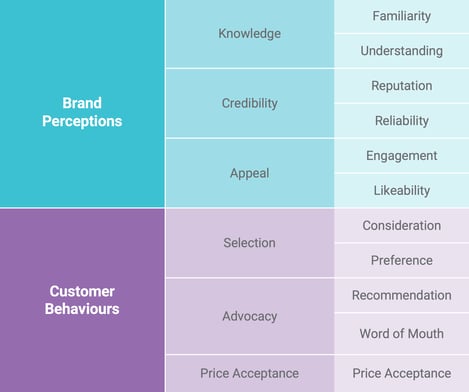
Board-Level Reporting: How to Present Brand Impact Credibly
Industrial and Manufacturing leaders understand that growth is multi-variable. Revenue moves because of pricing, operations, product performance, capital strategy, leadership changes, and market conditions. Brand is one contributor among many.
The story needs to respect that complexity.
Demonstrate:
-
What changed in the brand system
Clarified positioning, structured architecture, aligned messaging, disciplined governance. -
What the organization could do differently because of it
Sales adopted a repeatable narrative. Leadership spoke with one voice. Expanded capabilities were easier to explain. -
What changed in commercial performance
Movement in win rate, cycle time, pricing discipline, retention, or mix. -
What else was true at the same time
Operational improvements, product launches, acquisitions, market shifts.
When making a case for “brand as an asset,” some of this transparency may feel counter intuitive. But it is reality, and that is executive discipline.
The Leadership Implication
If you have read this far you are probably wondering how to guide your team in managing your brand.
When treated as an asset, brand cannot be episodic. It cannot depend on a campaign cycle or a new logo moment. Assets are governed. They are measured. They are improved over time against a stable core.
Here is one case study that might be of interest.
Here is one real world example of a brand being treated like an asset.
A disciplined brand governance loop connects market forces to structured discovery, clear definition, and consistent execution.
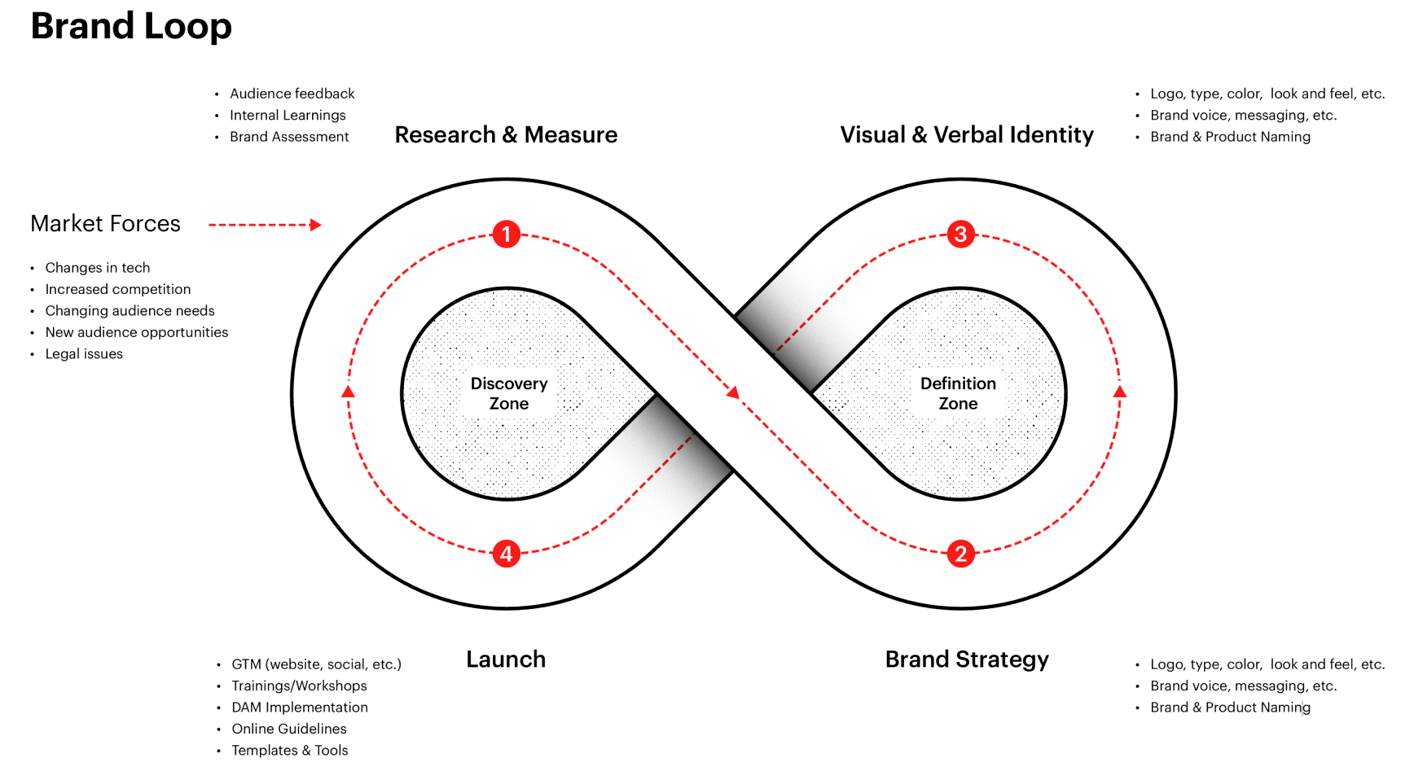
Instead of reactive refreshes, the organization makes incremental improvements to a solid foundation. The results:
- Clarity reduces friction in every deal.
- Reduced friction improves performance quarter after quarter.
- Consistent performance strengthens long-term brand value.
Our strongest advice: Find a brand consultancy transforming ambitious ideas into business results.
The Takeaway
Brand does not create value in isolation. It strengthens the mechanisms that drive revenue, margin, and trust in complex markets.
When governed, measured, and incrementally improved, brand becomes a durable contributor to cash flow and risk reduction.
For CEOs, the shift is simple but consequential: stop treating brand as a campaign expense and start managing it as a long-term asset.
Time to Take Action
- Gather historic performance of relevant internal metrics.
- Start a discussion with your finance leader: “As we think about brand as an asset, which financial levers do you think it most realistically influences for us?”
- Pull your CMO into the conversation: “If we were to invest meaningfully in our brand, where do you see that translating into tangible business impact?”
- Have a conversation with your CEO: “As you think about enterprise value over the next few years, where do you see brand playing a role, if any?”
- Explore a brand process geared toward increasing the value of your brand.
- Consider assigning brand governance to an executive leader.
What Questions Does This Article Answer?
- How does brand reduce friction in industrial sales environments?
- How does brand influence win rates, sales cycle length, and discounting?
- Why does brand matter more in complex, high-risk B2B buying decisions?
- What happens when a company’s capabilities evolve but its brand does not?
- How does brand clarity affect pipeline velocity and deal conversion?
- How should industrial companies think about brand as an asset instead of a marketing function?
- Can brand be measured in a way that stands up to CFO or board-level scrutiny?
- What does “brand value” actually mean in financial terms?
- How does brand contribute to enterprise value in manufacturing businesses?
- What metrics actually indicate that brand is creating financial value?
- How do you connect brand strength to revenue, margin, and cash flow?
- Why is stock price or IPO performance a weak way to prove brand value?
- How should executives interpret correlation between brand changes and financial performance?
- What is the correct way to present brand impact to a CFO or board?
- How should a CEO operationalize brand as a managed asset?
- What metrics should leadership track to evaluate brand performance?
- How do you define the value mechanism of brand inside a go-to-market strategy?
- Why is brand governance required for consistent financial impact?
- How does brand function as both a growth driver and a risk reduction mechanism?
- Where should a CEO start when evaluating brand as an asset?


